


Artificial Intelligence (AI) is no longer a concept of science fiction. It is already a part of our daily lives, from voice assistants and recommendation systems to smart cameras and automated customer support. As we move closer to 2030, the next four years are expected to bring major changes in how AI is developed, used, and regulated. This blog explores what the future of AI may look like by 2030 and how it will impact different areas of life, business, and society.
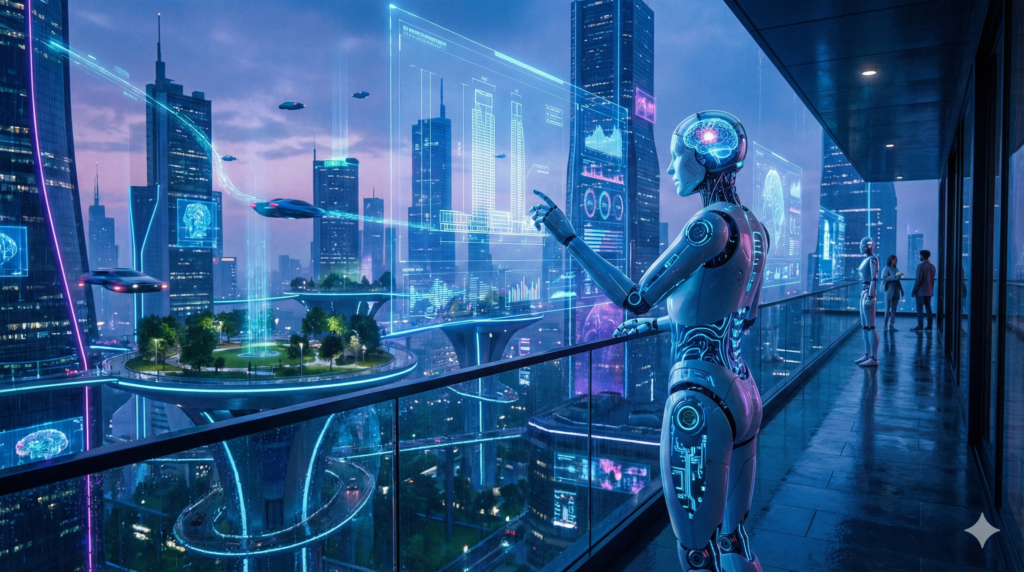
1. AI Will Become More Human-Centric
By 2030, AI systems will be designed to work more closely with humans rather than replacing them completely. The focus will shift from “automation only” to “augmentation,” where AI helps people make better decisions, work faster, and reduce errors. AI tools will understand human emotions better through voice tone, facial expressions, and behavior patterns.
For example, customer service chatbots will sound more natural and empathetic. In offices, AI assistants will help employees plan tasks, summarize meetings, and manage workflows. This human-centric approach will make AI more acceptable and trustworthy for users.
2. Strong Growth of AI in Healthcare
Healthcare will be one of the biggest beneficiaries of AI by 2030. AI-powered systems will help doctors diagnose diseases earlier and more accurately. Medical imaging, such as X-rays, MRIs, and CT scans, will be analyzed by AI to detect problems that the human eye might miss.
AI will also play a major role in personalized medicine. Based on a patient’s medical history, lifestyle, and genetics, AI can suggest customized treatment plans. Virtual health assistants will monitor patients remotely, remind them to take medicines, and alert doctors in case of emergencies. This will reduce hospital costs and improve patient care, especially in rural areas.
3. AI in Education and Skill Development
Education will change significantly with AI in the coming years. By 2030, AI-based learning platforms will offer highly personalized education. Students will learn at their own pace, and AI systems will adjust lessons based on strengths and weaknesses.
Teachers will use AI tools to automate tasks like grading and attendance, giving them more time to focus on teaching and mentoring. Virtual tutors powered by AI will be available 24/7, helping students clear doubts instantly. Skill-based learning will also grow, with AI recommending courses based on job market trends and individual career goals.
4. Transformation of Jobs and the Workplace
One of the biggest concerns about AI is job loss. While it is true that some repetitive jobs will be automated, AI will also create many new job opportunities. By 2030, demand will increase for roles like AI trainers, data analysts, AI ethicists, and automation specialists.
Workplaces will become more efficient with AI tools handling routine tasks such as data entry, report generation, and scheduling. Employees will focus more on creative, strategic, and problem-solving tasks. Remote and hybrid work models will improve further with AI-driven productivity and collaboration tools.
5. AI and Smart Cities
By 2030, many cities will become “smart cities” using AI to manage resources better. AI systems will control traffic signals to reduce congestion, monitor energy usage, and improve waste management. Smart surveillance systems will help enhance public safety while following strict privacy rules.
Public transportation will become more efficient with AI-powered route planning and predictive maintenance. These changes will make cities cleaner, safer, and more sustainable for growing populations.
6. Ethical AI and Stronger Regulations
As AI becomes more powerful, ethical concerns will also increase. Issues like data privacy, bias in AI algorithms, and misuse of AI technologies will demand attention. By 2030, governments and organizations are expected to introduce stronger AI regulations and guidelines.
Responsible AI development will be a top priority. Companies will be required to make AI systems transparent, fair, and explainable. Users will have more control over their data, and AI decisions affecting human lives, such as in finance or healthcare, will be carefully monitored.
7. AI in Business and Marketing
Businesses will heavily rely on AI by 2030 to stay competitive. AI will analyze customer data to predict behavior, improve targeting, and personalize marketing campaigns. Content creation, including text, images, and videos, will be faster and more cost-effective with generative AI tools.
In digital marketing, AI will optimize ads in real time, improve SEO strategies, and enhance customer experience. Small businesses will also benefit, as AI tools will become more affordable and easy to use, allowing them to compete with larger companies.
8. Advances in Generative AI
Generative AI will see massive improvements by 2030. AI models will create high-quality content that is almost indistinguishable from human-made content. This includes articles, music, designs, software code, and even movies.
However, this growth will also raise concerns about fake content and misinformation. To solve this, AI detection tools and content verification systems will develop alongside generative AI, ensuring authenticity and trust.
9. AI and Everyday Life
In daily life, AI will become more invisible but more powerful. Smart homes will automatically manage lighting, temperature, and security based on user habits. Personal AI assistants will help with shopping, travel planning, financial management, and health tracking.
AI-powered vehicles, including self-driving and semi-autonomous cars, will become more common by 2030, improving road safety and reducing traffic accidents. These technologies will save time and make life more convenient.
10. Challenges Ahead
Despite its benefits, AI will face several challenges by 2030. Data security, ethical misuse, and unequal access to AI technology are major concerns. Developing countries may struggle to adopt advanced AI due to lack of infrastructure and skilled professionals.
There is also a need for continuous reskilling of the workforce. Governments, educational institutions, and companies must work together to prepare people for an AI-driven future.
Conclusion
By 2030, Artificial Intelligence will be deeply integrated into almost every aspect of human life. It will improve healthcare, education, business, and city management while transforming the way we work and live. The next four years will be crucial in shaping how AI develops and how responsibly it is used.
The future of AI is full of opportunities, but success will depend on ethical development, strong regulations, and continuous learning. If guided correctly, AI by 2030 has the potential to create a smarter, more efficient, and more inclusive world for everyone.